Showing posts with label biology. Show all posts

Monday, July 25, 2016

Visualizing Natural Family Planning

Introduction

My wife and I use Natural Family Planning (NFP).  In fact, full disclosure, my wife teaches NFP.  For those that may not know, NFP is a way to achieve or avoid pregnancy naturally by using a woman's natural signs and observations throughout her cycle to determine the couple's fertility on any given day.  No, it's not the rhythm method.  It is actually quite effective in avoiding and achieving pregnancy, it encourages mutual support and communication about sex between the couple, and it does not require the use of hormones or devices to be effective.  Sounds pretty good, huh?  For more information, click here.

The specific brand of NFP we use is called the Creighton Model FertilityCare System.  As part of using this system, the couple charts the signs/observations for every day of the cycle on a paper chart.  When the cycle is complete, a new row on the chart is used.  This is repeated over and over for every cycle.  You get the following when you have completely filled out a chart:


At some point, I realized that my wife's many charts of her cycles formed a great dataset.  I know for every day of her cycle for the past 3 years what her fertility is and what the specific signs and observations associated with that day are.  I thought to myself, couldn't I visualize this data in a useful way to look at, say, a given day's likelihood of being fertile?  What other sorts of information could I gather from the charts?

Below are my observations and visualizations of what I uncovered about our use of NFP.  Yes, I am doing this with my wife's full knowledge, consent, editing, approval, and blessing.  Thanks for asking.  Yes, this is extremely personal, but I think it is worthwhile for our own and other's understanding of NFP and its uses.

If you are squeamish about topics related to sex, menstrual cycles, bodily fluids, and so forth, you probably should just stop here.  I'll try to be as clinical and impersonal as possible so that we can focus on the data and it's implications.

Understanding the Data

For every day, a user of the NFP system records several aspects of her fertility observations, which are recorded in the following way (for understanding more fully what this means, click here):
  • Color stamp:
    • Red (menstrual flow, spotting), Green (dry), Yellow (non-fertile discharge), White-baby (mucus), Green-baby (dry day within peak plus 3)
  • Number:
    • 0,2,4: various forms of dry observations
    • 6,8,10 - indicates the length of the mucus
  • Letters:
    • VL (very light), L (light), M (medium), H (Heavy.  Used on red days.
    • C (cloudy), K (clear), L (lubricative), P (pasty), B (brown), Y (Yellow), G (Gummy).  Used on mucus or discharge days.
  • xX or AD:
    • indicates number of observations.  E.g., x3 indicates 3 times observed that day.  AD means all day.
  • I: whether intercourse took place that day.

So, if you saw this:
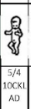
 
 
That would mean, "on 5/4 there was fertile peak type mucus that was peak type that was stretchy, cloudy, clear, and lubricative, and it was observed all day."
 
I converted this information into rows with the following columns:
  • Date
  • Day of cycle
  • Stamp
  • Number
  • Flow type (VL, L, M, H)
  • Type (0,4,6,8,10)
  • Letters (B, C, K, L, G, Y, P)
  • Duration
  • Intercourse
  • PeakDay
  • Avoiding?
  • Pregnant?
  • Nursing?
  • PostPartum?
  • PMS?
  • Headache?
  • Fertile?
There were 1,114 row (days) in the dataset, consisting of 36 cycles.
 
What can we learn from this dataset?
 

Analysis and Visualization

Time for the fun.  I'll be using this opportunity to explore Microsoft's latest Power BI offerings for visualization.
 
A typical cycle lasts about 26 days (26.33 days with standard deviation of 1.66).  The longest cycle is 29 days (excluding the cycle in which a conception occurred), or 31 (if we count up to the day of confirmed pregnancy).


Stamps

What does a typical cycle look like in this dataset?  Look at the graph below.  The day of the cycle is along the x-axis and the percentage of stamp type is along the y-axis.
 
Note: I couldn't rearrange the stacking order of the categories in PowerBI, so I used Excel for this chart.
 
The first five days are always menstrual flow.  Then this tapers off on days 6, 7, and 8 and gives way to either dry days (green) or fertile days (white).  The fertile days peak in days 11, 12, and 13 and then give way to discharge days (yellow) or dry days.  There are occasional spotting (red) days throughout and occasional fertile days near the end of the cycle. 
 
The rising and falling of each kind of stamp is more easily seen in the below chart.


Menstrual Flow

The first five days are always menstrual flow.  Then it declines to day 10.  The kind of flow changes over the course of this time period.  Usually, the first day is medium or heavy.  The second day is almost always heavy.  The third is usually medium.  Then we progress to medium or light, then light or brown, then very light or brown for the rest menstrual flow.  See the below chart.


So a typical progression could be medium, heavy, medium, light, very light, brown.
 

Type

Consider the ugly and poorly designed chart below of type of mucus.  This reflects how long the mucus can stretch.
 
Note: an example of what not to do in data visualization.
 
There is a lot going on and it is not easy to see (partly deliberate).  I'll bring out the important points and show the individual graph as well.
  • 0: dry days are rare except in two peaks.  The first is days 7-12, which is between the menstrual flow and the mucus buildup.  The second is after ovulation has occurred (the mucus), resulting in dry days for the rest of the cycle.

 
  • 2: relatively dry days are similar to 0 in exhibiting two peaks along the same lines, but with more counts.

 
  • 4: starts off at day 4 relatively high, then dips down a little during the mucus buildup.  There is a little peak after the mucus build up.  None of the peaks are very strong.

 
  • 6: for cloudy/pasty discharge there are two peaks.  The first is in days 5-8 (just after the menstrual flow but before any mucus).  The second occurs in days 15-18 (immediately after the mucus) and then steadily declines (giving way to dryer days).

 
  • 8: this mucus observation becomes more and more common, from nearly nothing, to peaking around days 14 and 15 (immediately after the peak in the cycle) and then suddenly dropping to very few for the rest of the cycle.

  • 10: this kind of mucus builds from nothing to peaking in days 10-13 and then declines again towards the end of the cycle.


The change from 2 peaks (0,2,4) to 1 peak (6,8,10) can be seen in the follow graph:
 
The color changes from light (0) to dark (10) as the type of mucus increases in value.  This is easier to see when I group 0,2,4 as light and 6,8,10 as dark:

Peak By Day

When does the cycle reach its peak?  On average, about15 days (14.62 with 2.09 standard deviation).  Along with the average length of a cycle, this results in a post-peak phase of about 11 days (11.57 with 2.08 standard deviation).  Below is a stacked area graph representing the counts of occurrences of the peak day (P) and days following the peak day (1-15) by the day of the cycle. 


 Note: I couldn't figure out how to reorder the legend to be P-15.  It treats it as categorical instead of numerical/linear.  Ideally, the P would be on the bottom of the stack, then 1, then 2, etc. through 15.
 
Since the above graph is a little difficult to understand (although perhaps intriguing), below shows only the peak day distribution:
 
Note: perhaps this area chart isn't the best option for displaying counts over time. 


PMS

PMS only seems to occur following the Peak day.  It increases in likelihood as one nears the beginning of the next cycle.  This should not be surprising as PMS is "pre-menstrual" and for many women seems to signal the coming of the next cycle.
 
Note: This chart is from Excel.  Power BI can't rearrange the X-axis appropriately.
 

Intercourse

When does intercourse occur?  Consider the below chart:


We see a general pattern that is similar to a pattern we have seen before.  A first peak at around day 7, then dropping down in the middle about day 14, and then another peak about day 23, and then falling again.  What is going on here? 
 
The peaks in intercourse correspond to infertile days, while the drop in the middle corresponds to the fertile days of a typical cycle.  And this should be no surprise for users of the system.  A couple will, when avoiding pregnancy (which may be most of the time), use infertile days for intercourse while avoiding fertile days.  This is easier to see in the following two charts which filter on the couple's use of the method: (1) avoiding a pregnancy and (2) not avoiding a pregnancy.
 
The first chart below shows the couple avoiding a pregnancy, and hence, only using the infertile days for intercourse.  This is why we see two peaks, corresponding to the infertile days in the cycle.


In this second chart, the couple is not avoiding a pregnancy, and hence, intercourse occurs throughout the cycle.


For a fuller picture, consider the following table:

Avoiding Pregnancy?
Fertile?
Intercourse
No Intercourse
Sum Of Row
Intercourse/Sum Of Row
No
Yes
28
50
78
0.36
No
No
51
127
178
0.29
Yes
Yes
7
394
401
0.02
Yes
No
171
285
456
0.38
Sum Of Column
 
257
856
1113
0.23
 
 
The couple has intercourse 23% of the time.  But this 23% is not equally distributed amongst fertile vs. infertile days and avoiding vs. non-avoiding days.  Starting with avoiding days, when the couple is fertile, about 2% of days are used for intercourse.  Note that this 2% would be an improper use of the system.  When infertile, 38% of the days are used for intercourse.  When not avoiding, the fertile days are used 36% of the time for intercourse; the infertile days are used 29% of the time.
 
Given the foregoing, we can calculate that 35% of the time, the couple has intercourse when the fertility is in line with the avoiding vs. not avoiding intention (that is, when excluding the days in which the couple is fertile but is trying to avoid a pregnancy).
 
Various sources online citing how often a couple has sex on "average" per year give numbers like 104, 112, 118, 124, 127.  So 29% to 35% of all days in a year.  Thus, the above is in the "normal" range.
 

Letters

I broke the Letters column into a column of "Yes" or "No" values for each letter - B, C, K, L, G, Y, and P.  For example, if "CKL" was recorded, then C, K, and L columns would have a "Yes" for that row, while the other letter columns would have a "No".  Let's look at each of these:
 

B

Brown spotting occurs usually during or right after the menstrual flow.  However, it also is known to occur at ovulation.  This is likely what happened on day 14.


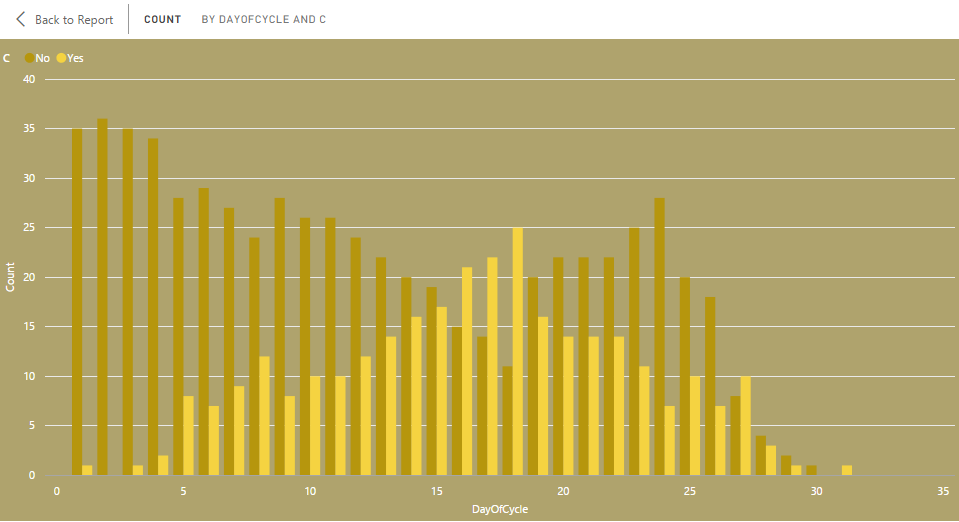
C

Cloudy mucus/discharge increases to a peak about day 17 and then declines afterwards.  This peak is right after the Peak day.  The C is associated with the yellow stamp, so it is not surprising that we see it following in much the same pattern.


K

K (clear) type mucus is associated with the buildup to and the occurrence of the peak of the cycle (e.g., ovulation).  So it is not surprising that Ks peak around days 11-13, right before and at a typical Peak day.  They fall back down again to almost nothing afterwards.


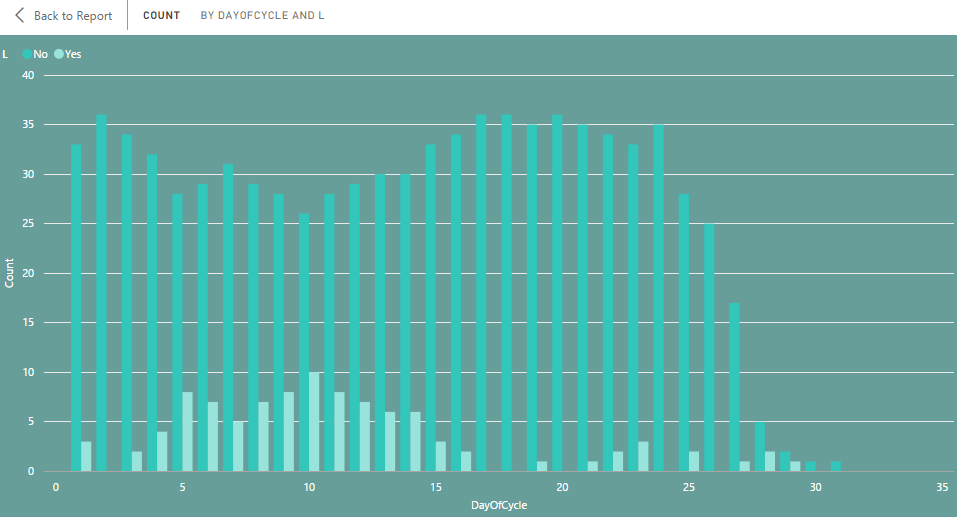
L

Lubricative days are also associated with fertility, and hence, appear most often in the buildup to and around the Peak day of the cycle.  These then decline afterwards with a few signs following after the peak.


G

Gummy type discharge doesn't really show any pattern.  While rare, it is distributed fairly evenly across the middle of the cycle, avoiding the very beginning and very ends of the cycle.


 P

Pasty discharge shows two peaks and is typically associated with the yellow stamps.  The first peak occurs right after the menstrual flow and then declines to almost nothing before the Peak.  Then it builds back up to day 18 as the mucus gives way.  It then declines again towards the end of the cycle.


Y

Yellow discharge doesn't show much of a pattern, except perhaps two groupings: right after the menstrual flow and right after the Peak day and following.  But this is also a pretty rare occurrence.


 Fertility

 
Finally, we can look at the fertile vs. non-fertile days.  Since red days and white days are treated as fertile, along with Peak 0,1,2 and 3 days, the fertile days follow the pattern of the red and white days put together along with the days just after the peak.


Summary

 In short, we can see that this woman's typical cycle lasts about 26 days, with ovulation (peak day as an estimate) occurring around day 15.  The menstrual flow lasts for 5 days before giving way to the mucus build up towards ovulation.  After the peak, discharge gives way to dry days as the cycle winds down to its end.  Then the cycle repeats.  Fertile signs occur in a single peak in the middle of the cycle, while infertile signs form two peaks on either side of the fertile peak.
 
Because the couple is using the system most of the time to avoid pregnancy, intercourse follows the pattern of infertile days: a smaller peak before ovulation and a larger peak after ovulation.  When the couple is not avoiding a pregnancy, intercourse occurs throughout the cycle.


Conclusion: Why It Matters

So what?  Why is this important?  Here are some data-driven/analytics reasons that one can see from the above data and charts above:
  • Predictability: a couple/woman that charts the cycle can get a sense of what is normal.  They/she can predict when the woman will be fertile or infertile based on past cycles. 
  • Planning: Predictability is especially useful when trying to achieve or avoid a pregnancy.  One can determine when to have intercourse so as to increase the chances of a pregnancy occurring (useful for couples struggling with infertility) or to avoid a pregnancy.  The woman can also determine when her next cycle is likely to begin, and can prepare for her menstrual flow.  Finally, other aspects associated with the cycle (e.g., PMS, headaches, cramping) can be recognized as cyclical/hormonal and prepared for/addressed appropriately.
  • Disease prevention and health awareness: a woman that knows what her typical cycle looks like can recognize an abnormal cycle, which can indicate various kinds of diseases or complications.  The woman's cycle is a great indicator of health and can point to hormonal imbalances, Polycystic Ovarian Syndrome (PCOS), abnormal bleeding, infertility, and many other health issues.
  • Infertility treatment: a couple trying to achieve a pregnancy can pinpoint the most fertile days.  Furthermore, a trained health professional can use the information contained in the chart to assess the couple for various kinds of infertility issues (e.g., limited mucus) and recommend treatments to increase fertility.
In addition to the above considerations, here are some other more philosophical considerations that are not based on the above data:
  • Hormone free, all natural, green, organic sex: the couple requires no birth control devices, barriers, hormones, pills, or chemicals for an effective method of achieving and avoiding a pregnancy.
  • Ethical: some couples may be concerned about the ethics of the potential abortifacient mechanisms of birth control methods or in using assisted reproductive technologies, such as in vitro fertilization.  These natural methods avoid those ethical concerns for both avoiding and achieving a pregnancy.
  • Communication: the system encourages and to a certain extent requires the couple to communicate about their sexual health and intentions with regards to achieving or avoiding a pregnancy.  It is a shared system in which all information is available to both the man and the woman.  Each month, the couple revisits questions related to achieving or avoiding a pregnancy to help the couple remain on the same page in regards to their sex and family life.

In short, there are both good philosophical and analytical reasons for using NFP.  If you are interested in finding out more about this, click here

In any case, the data generated by users of the system provides a fruitful and interesting area for exploration and discovery, not only about oneself, but also about health, fertility, and sex in general.


Monday, April 11, 2016

In Response to Craver: A Defense and Critique of the HPC View of Natural Kinds (1)

I wrote this paper for a Philosophy of Science class while completing my MA in Philosophy.  This was submitted on November 29, 2011 and remains as I submitted it (apart from formatting changes).
_______________________________________________________________________________

Introduction


The Homeostatic Property Cluster (HPC) view of natural kinds is an attempt to reconcile the heterogeneity found within kinds (particularly biological kinds like species) with the fact that kinds are nevertheless non-arbitrary categories that are useful in scientific theories (Brigandt 4).  While the HPC view is now generally regarded as the best approach to natural kinds, it is not without its critics.  One such critic is Carl Craver, who argues in “Mechanisms and Natural Kinds” that the HPC view incorporates conventionalist elements into its theory.  If so, then the HPC view is not the realist theory of natural kinds it claims to be and thus cannot “serve as an objective arbiter in scientific disputes about what the kinds of the special sciences should be” (Craver 575).    In this paper I will briefly explain what Craver takes to be the HPC view and then explain his criticisms.  Following, I will defend and critique the HPC view.  I find that Craver has mischaracterized the HPC view, but that his mischaracterization rests on plausible assumptions that the HPC view denies.  Thus, I believe that many of Craver’s underlying concerns are legitimate.  I conclude by explaining how an HPC theorist might accommodate Craver’s assumptions while still resisting his conclusion, thereby finding that a suitably revised HPC view is a realist approach to natural kinds.

The HPC View


According to Craver, the HPC view claims that natural kinds track mechanisms that sustain property clusters in a stable way.  Craver defines mechanisms as “entities and activities organized together such that they do something” (Craver 582).  When it comes to homeostatic mechanisms, the entities and activities organized in a certain way have the power to generate and sustain property clusters that we pick out as making up a kind.  Thus, it is because of the operation of these homeostatic mechanisms that these property clusters exist.  As such, one can use homeostatic mechanisms to individuate kinds (and so these can be thought of as essences of the kinds); the natural kind is delineated by the homeostatic mechanism(s) that sustain(s) it and so the homeostatic mechanisms “determine the boundary and integrity of the kind” (Brigandt 9).[1]  Mechanisms can operate on both relational (external) and intrinsic (internal) properties and so whether an individual is part of a natural kind partly depends on features external to that individual (Boyd 153, Brigandt 5). [2] 

The HPC view, as Craver understands it, is supposed to offer an objective view of natural kinds.  The homeostatic mechanisms “constitute the causal structure of the world,” and so “nature’s joints are located at the boundaries of mechanisms” (Craver 575).  Natural kinds are “real divisions in the structure of the world,” and these divisions track the divisions of homeostatic mechanisms (Craver 577).  Thus, kinds are given to us by nature; they are discovered, not created.  However, because kinds track the causal structure of the world by following divisions among mechanisms, they are useful and predictive in scientific theories that use the property clusters to make generalizations and predictions.     

The HPC view sits between essentialism on one side and conventionalism on the other.  Traditional essentialists claim that “natural kinds are defined by necessary and sufficient conditions, that is, the set of properties shared by all and only members of the kind” (Craver 577).  The HPC view differs from essentialism in that no set of properties is necessary and sufficient for kind membership.  A member of a kind merely needs to have enough properties that are part of a property cluster that defines a kind.  Furthermore, HPC theorists take natural kinds to have fuzzy boundaries, whereas an essentialist will have clear boundaries regarding which entities are members of a kind and which members are not.  The lack of clear boundaries allows HPC theorists to count biological kinds as natural kinds in spite of the great variability amongst individuals that seems to preclude necessary and sufficient conditions for kind membership. 

On the other side, conventionalists about natural kinds claim that “the difference between natural kinds and merely conventional property clusters lies not in the phenomena themselves but in the psychological or social factors that determine how human beings find it useful to chunk the world for a given purpose” (Craver 576).  That is, “natural” kinds are merely those property clusters that humans find most interesting and important for their purposes but which are not grouped by anything purely natural or objective with regards to the structure of the world.  Thus, “some kinds are more useful or interesting to us than others, but there is no (or need be no) further fact about the world that explains why this is so.  The natural kinds are merely the useful ones” (Craver 577).  In contrast, the HPC view wishes to preserve the naturalness and objectivity of natural kinds, locating this naturalness in the features of entities themselves and not merely in the usefulness that such groupings provide for humans. 

There is one final aspect of the HPC view as traditionally formulated by Boyd that needs to be discussed: the Accommodation Thesis.  Craver understands the Accommodation Thesis as claiming that “any refinement of the definition of the kind either introduces causally and inductively irrelevant distinctions or glosses over causally and inductively relevant similarities” (Craver 578).  What does this mean?  Craver gives two possible interpretations.  The first is a strong reading that claims that “the correct taxonomy of natural kinds must be immune to revision in light of future discoveries about the mechanistic structure of the world” (Craver 579).  This would suggest that the correct taxonomy will never need to be adjusted in light of future discoveries and so it does in fact categorize the world correctly.  The second is a weaker reading that our taxonomy of kinds should “pick out sets of things that are similar enough for our explanatory or instrumental projects” (Craver 579).  On this reading, what matters is that our taxonomy serves the purposes of scientists and so a “correct” taxonomy will continue to do so in the future.  Which of these two readings is correct will be addressed in responding to Craver’s fifth objection.


Continued on page 2
      

In Response to Craver: A Defense and Critique of the HPC View of Natural Kinds (2)

Continued from page 1


Objections


Let us now turn to Craver’s objections to the HPC view and his contention that it does not avoid incorporating conventionalist elements into its theory.  The first challenge Craver poses for the HPC view is to specify which homeostatic mechanisms are identified with which natural kinds and to give an explanation for this association that does not rest on perspectival or pragmatic considerations (Craver 578).  Craver points out that any given natural kind is involved in many homeostatic mechanisms and that “one can be led to lump or split the same putative kind in different ways depending on which mechanism one consults in accommodating the taxonomy to the mechanistic structure of the world” (Craver 583).  That is, if we attend to some mechanisms, we will lump our kinds; if we attend to others, we will split our kinds (Craver 584).  Thus, it appears that there is no final and correct way of delineating the kinds objectively and naturally.

If this is the case, then what ultimately decides whether we should lump kinds or split a kind?  Craver believes that pragmatic and perspectival considerations decide.  We should be pluralists about kinds, taking there to be “as many kinds as there are distinct and dissociable mechanistic entanglements,” and when conflict arises as to how we should define a kind, we should make our decision based upon what we are trying to “understand or to do” (Craver 584).  This means that two scientists that are trying to solve different problems may legitimately classify kinds in different ways to suit their purposes, and neither will be able to claim that her taxonomy is more “correct.”  While both will rightly appeal to the causal structure of the world to ground their claims, they will be attending to different mechanisms to define the kinds, and there is no way of privileging one classification scheme over another except by appealing to pragmatic considerations.  But as soon as we appeal to pragmatic considerations in our taxonomy, we will have introduced a conventionalist element into our taxonomy and the HPC theorist can no longer say that the HPC view delivers kind classifications that are wholly objective and natural.

Craver’s second challenge to the HPC view is that it cannot tell us when two mechanisms are of the same kind.  Identity conditions of mechanisms need to allow for “variability among instances of the kind” and allow for “variability in the mechanisms” that realize the kind (Craver 586).[3]  Given this variability, we have a situation that is similar to the Generality Problem for process reliabilism in epistemology, namely, that we cannot specify the appropriate level of generality for the kinds of mechanisms with which we wish to identify kinds.  Craver claims that too abstract a characterization will gloss over sub-kinds in mechanisms while too detailed a characterization will “make each particular mechanism a kind unto itself” (Craver 587).  Between these two extremes there are no objective features to ground a certain level of abstraction, and so what will decide the appropriate balance of abstraction and detail in the characterization of a kind of mechanism will be “what we want to do with the schema” (Craver 588).  That is, practical and theoretical considerations will decide how we characterize a kind of mechanism, and not the objective features of the natural world.  And “if there is no objectively appropriate degree of abstraction for typing mechanisms, then judgments about whether two mechanisms are mechanisms of the same kind rely ineliminably on judgments by people (in concert) about the appropriate degree of abstraction required for the problem at hand” (Craver 589).  To allow for this is to allow for conventionalist elements to creep back into the HPC view of natural kinds and to lose the purely objective feature that HPC kinds are supposed to have.

The third challenge Craver poses to the HPC view of kinds is that it cannot provide objectively determined boundaries for mechanisms; it cannot tell us which “entities, activities, and organizational features are part of a mechanism (or kind of mechanism) and which are not” (Craver 589).  In the absence of purpose, goals, forms, designs, and teleology in nature, Craver claims that we cannot divide entities into parts (Craver 589).  And since we cannot say which parts are involved in an entity, we cannot specify the boundaries of that entity.  As Craver puts it, “the spatial and causal boundaries of mechanisms depend on the epistemologically prior delineation of relevance boundaries. But relevance to what?  The answer is: relevance to the phenomena that we seek to predict, explain, and control” (Craver 590, original emphasis). 

Consequently, the boundaries of mechanisms will be fixed by pragmatic and theoretical considerations of scientists and not solely by the objective and natural features of mechanisms.  Mechanisms will contain “all and only the entities, activities, and organizational features relevant to the phenomenon selected as our explanatory, predictive, or instrumental focus” (Craver 590).  If this is the case, then how we explain the structure of the natural world will depend “upon our explanatory interests and our descriptive choices at the level of property clusters,” meaning that conventionalist elements have once again entered into our supposedly objective classificatory scheme of the natural world (Craver 590-1).  Thus, HPC natural kinds are not truly natural in the full sense that HPC view adherents are supposed to desire.

A fourth concern that Craver has about the HPC view is that scientists define kinds by property clusters that figure in “important causal generalizations” (Craver 578).  Craver focuses on the word “important” because this rules out defining kinds according to property clusters sustained by mechanisms that “are of little or no theoretical or practical value” (Craver 578).  As soon as we include normative notions such as “important” into our classification scheme, we will have introduced a conventionalist element since what is “important” depends on “whether the kind in question appears in our theories or is otherwise important for our aims and objectives,” and this is to destroy the purely objective and natural divisions of kinds (Craver 579).  One might give up on “important” causal generalizations and say that kinds are grouped by a “mere causal relevance” of the cluster to something else.  However, Craver argues that this solution increases promiscuity such that “there are many more natural kinds than science will ever find it useful or interesting to recognize, let alone study,” and presumably, this is an unacceptable result (Craver 579).

Fifth and finally, Craver takes the Accommodation Thesis to be flawed.  Craver contends that both readings lead to problems in that the strong reading is “untenable” while the weak reading is “too weak to avoid conventionalism” (Craver 580).  The strong reading is untenable because our kinds are revised upon further evidence that a differing scheme better fits with the causal structure of the world, and there is no guarantee that the kinds that we use now will in fact be used in the future (e.g., phlogiston).  The weak reading is also problematic because things that are “similar enough” will use terms that gloss over causal differences for the sake of defining a kind that fits human concerns, and this is to make kinds subjective and conventionalist.

Continued on page 3
     

In Response to Craver: A Defense and Critique of the HPC View of Natural Kinds (3)

Continued from page 2

Response


If Craver is correct in these objections, then the HPC view is an extremely nuanced and useful, but nevertheless conventional, view of natural kinds, and so the HPC theorist must make a response.  But before I do, I must note that my response assumes two theories to be correct: Shoemaker’s Causal Theory of Properties[4] and Gillett’s Theory of Compositional Relations.[5]  With these two theories in mind we can now address Craver’s challenges.  I take up the fifth objection first because I believe Craver has created a false dichotomy and hence has misconstrued the Accommodation Thesis.  Boyd, the originator of the HPC view, is concerned with inductive practices and generalizations which he takes natural kinds to be primarily used for.  As such, he believes that we should accommodate our language and practices to the causal structures that underpin our generalizations (Boyd 148).  Boyd takes kinds to be constrained by the causal structure of the world, and so it is not the case that any classification scheme will do so long as it serves our instrumental purposes.  However, “many – but not just any – mind-independent causal relationships exist, and biologists pick out those which accord with their varied lines of inquiry” (Lockwood 23).[6]

This means that while Boyd is a realist about species, he is a species pluralist, since “natural kinds, including species, are discipline relative” (Lockwood 23).  That is, there are as many “correct” ways of grouping individuals under natural kinds as there are purposes for doing so, as long as these groupings do not violate the causal structure of the world.  As Lockwood puts it, “there are many relations that could be used to delimit species and none of these has a privileged status as long as the different perspectives meet the criteria of integrating objective features of the world with the subjective desires of scientists” (Lockwood 23-4).  Thus, Craver has created a false dichotomy.  The HPC view does not claim that either natural kinds are immune to revision or that scientists are allowed to gloss over causal differences if individuals are “similar enough” for their purposes.  Instead, natural kinds are constrained by the causal structure of the world, but since the causal structure on its own does not group individuals into useful kinds, scientists must group individuals based on their usefulness and based on the causal structure of the world.

Now consider Craver’s first objection that the HPC view cannot specify which homeostatic mechanism to identify a kind with.  Craver seems to assume that there is only one homeostatic mechanism that defines a kind: “if you find that a single cluster of properties is explained by more than one mechanism, split the cluster into subset clusters, each of which is explained by a single mechanism,” whereas “if you find that two or more putatively distinct kinds are explained by the same mechanism, lump the putative kinds into one” (Craver 581).  However, there is nothing in the HPC view that demands that we must define a natural kind by a single homeostatic mechanism.  Usually several mechanisms work together to define a kind, and supporters of the HPC view explicitly endorse this conclusion (Boyd 165, Brigandt 26).  The HPC view can appeal to all and only those mechanisms that sustain the relevant property cluster and this will mean that a kind will generally be identified by many mechanisms.  Perhaps we should say that these many mechanisms form a single causal process and it is this causal process that defines the natural kind.  

Even if we cannot do this, notice that HPC theorists like Boyd and Brigandt have explicitly embraced kind pluralism.  So Craver’s objection that the HPC view leads us to kind pluralism is no objection.  Furthermore, pragmatic considerations are permitted in defining kinds so long as these do not violate the causal structure of the world, and so HPC theorists agree with Craver that there will be no “correct” way of carving up the world.  But scientists are not arbitrarily creating kinds; these kinds follow the causal structure of the world in that they are supported by homeostatic mechanisms that sustain the property clusters that are associated with kinds.  Thus, Craver has simply misunderstood what he takes his opponents to assert.

Craver’s second contention that the HPC view cannot tell us when two mechanisms are of the same kind and that one must appeal to pragmatic considerations to specify the appropriate level of generality can be answered in the following way.  Recall that a mechanism consists of entities and activities that do something given their organization, “something that the components could not do on their own” (Craver 582).  However, he worries that “mechanisms that produce the same effects with different components should be lumped on the basis of their effects and split on the basis of their constitutive mechanisms,” and thus there is no objective way of deciding when to split or when to lump (Craver 584).  But if we recognize that mechanisms are primarily defined by their effects (that is, their causal powers), then we should always lump mechanisms that produce the same effects (even with different components) and only split mechanisms when the effects they produce are different.  As such, we are merely affirming that mechanisms can be multiply realized and that what matters are their causal powers, not what they consist of.  We can ignore the fact that different entities and activities may be involved in generating these causal powers.  These differences are not glossed over by abstraction, but instead are irrelevant to the identity of mechanisms, whose identity is fixed by their effects.  Thus, two mechanisms are of the same kind when they have the same powers, and this is an objective matter.[7]

Even if this solution does not work, once again the HPC theorist can appeal to pragmatic considerations so long as these do not violate the causal structure of the world.  Thus, it may be appropriate to use varying degrees of abstraction of mechanisms for different purposes and this is permitted by the HPC view.  One way of doing this is to admit that there are no necessary and sufficient conditions for the identity of mechanisms.  Instead, two mechanisms are members of the same kind when they each have a set of powers that is part of a cluster of powers associated with the kind of mechanism.  In any case, both of these proposed solutions meet Craver’s objection and so his second objection fails.

Moving on to the third objection that there are no objectively determined boundaries for mechanisms, one can appeal to Gillett’s Theory of Compositional Relations.  This theory asserts that components are spatially located within the composite entity, powerfully related to each other, and together realize the powers of the composite entity.  Translating to apply to mechanisms, we can say that the entities, activities, and organizational features of a mechanism that define a kind are those that (1) are spatially located with the members of the kind, (2) that powerfully interact with each other, and which (3) together produce/realize the characteristic effects/powers of the mechanism (which sustains the property cluster that is associated with the kind).  Any entity, activity, or organizational feature that fails to satisfy (1)-(3) is excluded as a part of the mechanism, and so we have a non-arbitrary and clear way of marking the boundaries of any given mechanism that does not rely on pragmatic and theoretical considerations.

This takes us to Craver’s fourth concern that scientists define kinds according to “important” causal generalizations and that giving up the notion of importance leads us to kind promiscuity.  As we have already seen, HPC theorists explicitly embrace the use of “importance” in marking kinds and also embrace a plurality of kinds.  Boyd believes that given the structural complexity of the natural world (particularly in biology), scientists will be faced with differing accommodation demands in their differing scientific disciplines, and so will need to use different natural kind terms that cut across each other (Boyd 160).  However, since “different ways of demarcating species can correspond to different objective structures,” we can “thus define species categories that are equally real” (Boyd 170).  Thus, far from being an objection to the view, HPC theorists take Craver’s concern to be a good feature of the view. 

Consequently, each of Craver’s objections has failed and so the HPC view, as it currently stands, is a coherent view.  However, I think that Craver’s worries all stem from an implicit demand for (1*) necessary and sufficient conditions at some level to mark the boundaries of natural kinds and kind membership, and (2*) a desire to give an account of natural kinds that is purely objective and natural without any dependence on human interests and that (3*) carves up the world in a single correct way. Should we have a theory that seeks to meet these demands?  Can the HPC view meet these demands?

Critique


Considering necessary and sufficient conditions, Boyd and his followers reject such a demand[8] because they believe that “the relevant question is not so much into which metaphysical category species and higher taxa fall, but how biological accounts of taxa (such as species concepts) underwrite classifications and generalizations, shed light on the unity of taxa across time, and permit explaining their ability to undergo change as a unit—all of which are epistemic issues” (Brigandt 30).  Thus, many HPC theorists take natural kinds to be primarily epistemic categories instead of, and even at the cost of their being, metaphysical categories; natural kinds exist primarily to serve scientific inductive and generalization needs while metaphysical issues are pushed to the side.[9]  As such, Boyd, Brigandt, and other similar HPC theorists also reject (2*), which leads, as we have seen, to a rejection of (3*).

Should HPC theorists say this, even if their view is coherent?  I think not.  Consider some costs and implications.  First, both the essentialist and the conventionalist seem to take the debate to be metaphysical.  The conventionalist seems to claim that natural kinds are not metaphysical categories, though they are extremely useful epistemic categories; they are merely a useful fiction imperfectly based upon the causal structure of the world, but such a useful fiction is not enough to call them “real” or “natural.”  The essentialist, responding to the conventionalist, likewise assumes that the debate is over whether kinds are ontological, and seeks to give necessary and sufficient conditions for kinds that would establish a metaphysically robust categorization of the natural world.  As such, it seems that Boyd, Brigandt, and similarly minded HPC theorists have shifted the debate to scientific epistemology instead of ontology.  Vague boundaries will do if we are concerned merely with scientific practice, but not if we are doing ontology and trying to make identity claims.

Second, if Boyd and Brigandt are correct, then no way of categorizing the world is ontologically privileged, and so we cannot say what deeper kind any entity falls into or what that entity fundamentally is.  But isn’t the question of, for example, “what am I?” important and meaningful?  Isn’t there a definite answer to that question?  It is not satisfying to say that for some purposes I am a human but for others I am not, for this seems to actually be a kind relativism instead of a pluralistic realism.  Whatever I am, I do not change depending on any scientist’s particular interests and so my fundamental kind, whatever it is, cannot change; my metaphysical identity is fixed.  In order to provide the creation, persistence, and destruction conditions for any individual, that is, its identity conditions, we must figure out which deeper kind it belongs to and so we must have a way of privileging some natural kinds over others.

Third, the HPC view as Boyd and Brigandt present it is a strange form of scientific realism.  They claim that there is no objective, correct, or discipline-independent way of carving up the structure of the world, and that kinds are discipline-relative (Boyd 148).  By making a kind’s “naturalness” dependent on whether it is useful for us and only within a certain field of inquiry, HPC theorists have made kinds hostage to our disciplinary interests.  But what is natural or real about a kind that exists only insofar as it is useful for scientists to invoke it in successful and important causal generalizations?[10]  Such kinds may not violate the causal structure of the world, but even conventional kinds can often claim as much, and they like Boyd’s HPC view rely heavily on human interests in fixing kinds.

Given these considerations, I think it is a mistake to give up on (1*)-(3*) and so one should not abandon an essentialist view but instead should seek to modify it.  Fortunately, the HPC view can be suitably modified to satisfy (1*)-(3*).  To repeat some of my previous claims made in response to Craver’s criticisms, mechanisms are individuated by the powers they contribute in the world.[11]  Since a natural kind will have a property cluster that is sustained by many mechanisms, the kind will be individuated by the set of mechanisms (which may be called a single causal process) that sustains the cluster of properties that members of the kind have.  Differing natural kinds need not appeal to the same mechanisms to define the kind.  Instead, what is important is that we appeal to all and only those mechanisms that sustain the property cluster found among a set of individuals.[12]

We can and should expect some variety in the properties of the members of a kind since the members will be interacting with other mechanisms that do not define their kind (e.g., environmental background conditions).  This is precisely why higher science laws are not exceptionless, due to the fact that there are many conditional powers operating amidst differing background conditions.[13]  Other varieties can be explained by the fact that mechanisms may sustain clusters of properties and not any single property (e.g., maleness and femaleness is sustained by interbreeding).  As such, this revised view can also account for the intrinsic heterogeneity that is common in biological kinds that “subsume individual entities (e.g., organisms) whose variation from one another is a natural part of what it is to be a member of those kinds” (Wilson 6).  When the variation becomes too great, we can attribute this to the breakdown of mechanisms that have sustained a kind, leading to speciation as a result of the new mechanisms that form and operate on existing individuals (Rieppel 41).  Thus, we can say that when the causal process with which a species is identified no longer operates, then that species no longer exists. 

Furthermore, we can capture the essentialist intuition by saying that members of a natural kind all have the property of having participated in the same causal process.  Participating in the causal process definitive of the natural kind is a necessary and sufficient condition for one’s being a member of that kind.  The “scope” of the kind extends as far as the mechanisms that sustain the property clusters in a kind operate (Magnus 7).  Thus, contrary to the common HPC view that rejects essences[14], we can say that since the causal process universally operates on members of a kind, is responsible for the kind’s typical traits, and explains why the kind has these traits, the causal process is the essence of the kind.

In conclusion, while Craver has not offered any decisive objections to the HPC view as traditionally formulated and defended by Boyd and others, he does notice some difficulties for the HPC view that I believe should lead us to modify the view.  This modification takes the best of both the essentialist and HPC views and consequently avoids the conventionalist elements that drive Craver’s concerns.

Works Cited and Consulted


Aizawa, Kenneth, and Carl Gillett. “The Autonomy of Psychology in the Age of Neuroscience.”
            Causality in the Sciences. Ed. Phyllis McKay Illari, Federica Russo, and Jon                  
            Williamson. Oxford: Oxford University Press, 2011.  202-223 (1-30). Print.

Boyd, Richard. “Homeostasis, Species, and Higher Taxa.” Species: New Interdisciplinary
            Essays. Ed. Robert Wilson.  Cambridge, MA: MIT Press, 1999. 141-185. PDF file.

Brigandt, Ingo. “Natural Kinds in Evolution and Systematics: Metaphysical and Epistemological
            Considerations.” Ingo Brigandt – Publications. University of Alberta, n.d. Web.  9 Sept.  
            2011.

Craver, Carl.  “Mechanisms and Natural Kinds.”  Philosophical Psychology 22.5 (2009): 575-
            594.  Philosopher’s Index. Web. 9 Sept. 2011.

Gillett, Carl.  “Hyper-Extending the Mind?  Setting Boundaries in the Special Sciences.”
            Philosophical Topics 35.1-2 (2007). Philosopher’s Index.  Web. 9 Sept. 2011.

Lockwood, Jeffrey.  “Species are Processes: A Solution to the ‘Species Problem’ via an
            Extension of Ulanowicz’s Ecological Metaphysics.” Axiomathes (2011): 1-30.            
            SpringerLink. Web. 9 Sept. 2011.

Magnus, P.D. “Drakes, Seadevils, and Similarity Fetishism.”  Biology and Philosophy (2011): 1-
            14. SpringerLink. Web. 9 Sept. 2011.

Rieppel, Olivier.  “Species as a Process.”  Acta Biotheoretica 57.1-2 (2009): 33-49.
            SpringerLink. Web. 9 Sept. 2011.

Wilson, Robert, Matthew Barker, and Ingo Brigandt.  “When Traditional Essentialism Fails:
            Biological Natural Kinds.”  Ingo Brigandt – Publications. University of Alberta, n.d.       
            Web.  9 Sept. 2011.


Footnotes


[1] As Magnus similarly concludes, HPC kinds are “unified by the underlying causal mechanism that maintains them… [It is] a complex of related property clusters kept in relation by an underlying causal process” (Magnus 1).

[2] Examples of homeostatic mechanisms for species include “unique common evolutionary origin” (Rieppel 34), “social roles” (Boyd 153), “gene exchange between certain populations and reproductive isolation from others, effects of common selective factors, coadapted gene complexes and other limitation on heritable variation, developmental constraints, the effects of the organism-caused features of evolutionary niches” (Boyd 165), and other “historical relations among the members” (Magnus 8). 

[3] Such variability includes the multiple-realizability of mechanisms by different component entities and activities.  But Craver seems to take the multiple-realizability of mechanisms to be incompatible with objective natural kinds.  Consider what he says:
               
The same kind of mechanism (as described in an abstract model or schema) can be realized with variable components and variable organizational features. Presumably the variability in underlying mechanisms (or environmental constraints) accounts for the variability in the properties of the cluster instantiated in any member of the kind and in the specific causal relations that the member of the kind has with its environment. If the kind is variable in its properties, it is bound to be variable in at least some of its causal relations. If the underlying mechanism is different, then there are bound to be differences in the ways that    the mechanism behaves or, at least, in the ways it responds to interventions. (Craver 586)


[4] Shoemaker claims that what makes a property as used in the sciences the property it is “is its potential for contributing to the causal powers of the things that have it” (Shoemaker 114).  A property is thus individuated by the powers it contributes, where a power is understood to be a fundamental entity that, by its intrinsic nature, makes certain effects happen under certain conditions.  This means that if two properties contribute all of the same causal powers under the same conditions to the entities that have them, then they are the same (i.e., identical) properties.  Similarly, if two properties contribute different powers under the same conditions, then these properties are not identical.   It also means that if an entity has a certain property, then that entity has a conditional power (that is, a power that can manifest in certain effects under certain conditions) (Shoemaker 115).  Thus, properties can be dispositional.

[5] Gillett takes compositional relations to be forms of non-causal determination that hold between qualitatively different relata.  In instances of composition, many lower-level components non-causally determine a qualitatively different higher-level entity under certain background conditions.  These component parts are (1) spatially contained within the higher-level individual, (2) these components bear powerful relations to each other, and (3) their powers and properties realize those of the composed higher-level individual (Gillett, “Hyper” 170).  That is, components are located within the boundaries of the composed entity, these components causally interact with each other, and these causal interactions and properties of these components non-causally determine those powers and properties of the composed entity.

[6] Consider an illustration.  A piece of grid paper may be colored in many different ways.  One can follow the lines or simply ignore them.  The essentialist will say that there is one correct way of coloring the paper.  The conventionalist takes there to be no wrong way to color the sheet and so the grid lines do not matter in constraining one’s coloring.  An HPC theorist would insist that there is no single correct way of coloring the paper, and many people may color the paper in different ways legitimately.  However, one must color by following the lines.  One cannot cut a box in two with two different colors, for this is to violate the structure of the grid lines and to color completely according to one’s own purposes, which is wrong.  Similarly, scientists may choose different groupings of kinds (ways of coloring) for different lines of inquiry that match the causal structure (lines) of the world but which also serve their practical purposes. 

[7] Craver’s real issue seems to be that he denies multiple-realizability.  Aizawa and Gillett notice that in other work Craver seems to rely on the “No Dissociable Realization” principle, which states that “instances of a property have one and only one realizer.  If there are two distinct realizers for a putative instance of a property, then there are really two properties, one for each realizer” (Aizawa and Gillett, 21).  Similarly, Craver reasons that because there are many entities and activities that may make up a “kind” of mechanism, and many mechanisms that may make up other “natural kinds,” then there should only be one set of entities and activities per kind of mechanism, and only one mechanism per natural kind.  But there is no reason to believe that simply because a kind is sustained by many different mechanisms then it cannot be a natural kind, and no reason to believe that a kind of mechanism cannot be made up of many different entities and activities.  If differing mechanisms have conditional powers that operate in the same way under the same conditions, and differing entities and activities also have the same conditional powers under the same conditions, then it is possible for both differing entities/activities and mechanisms to realize the same mechanisms and natural kinds, respectively.  In this case, the lower-level realizers are “orthogonal” to the higher-level entity produced because differences among the realizers do not lead us to posit a different kind of entity; the same entity is multiply-realized (Aizawa and Gillett 2-3).

[8] Boyd takes this demand to be an illegitimate leftover of the empiricist tradition (Boyd 151).

[9] Boyd explicitly states this by denying that “the issue is one regarding the metaphysical status of the families consisting of the members of the kinds in question – considered by themselves – [when it is rather] one regarding the contributions that reference to them may make to accommodation” (Boyd 159).

[10] (Boyd 176)

[11] As Aizawa and Gillett similarly claim, “processes in the sciences are grounded by the manifestation of the powers contributed to individuals by such properties and we therefore plausibly have different kinds of process where we have different properties and powers” (Aizawa and Gillett 3). 

[12] Doing so allows us to keep the “species” category without having to break it up into three distinct categories as Ereshefsky does (Wilson 25).  Some species will have property clusters sustained by interbreeding, others by common descent, and still others by ecological selection, but all are still correctly called species.

[13] Boyd agrees: “we characterize the homeostatic property cluster associated with a biological species as containing lots of conditionally specified dispositional properties” (Boyd 165). 

[14] Wilson 6-7